History
Anatol Josepho and the Photomaton
The inventor behind a machine that could make a portrait without a photographer.
A camera alone was not enough. Josepho’s problem was to arrange the sitter, control the light, expose the image and produce a usable photograph in a public, self-service machine.
Follow the documents
The National Archives of Hungary reconstructs Josepho’s work through patent files and contemporary reporting. It describes a New York prototype in July 1925, smaller studios during 1925–1926, and an expanded Broadway studio in September 1926. These are stronger distinctions than the familiar one-line invention story.
Evidence: Archival research
The face behind the invention
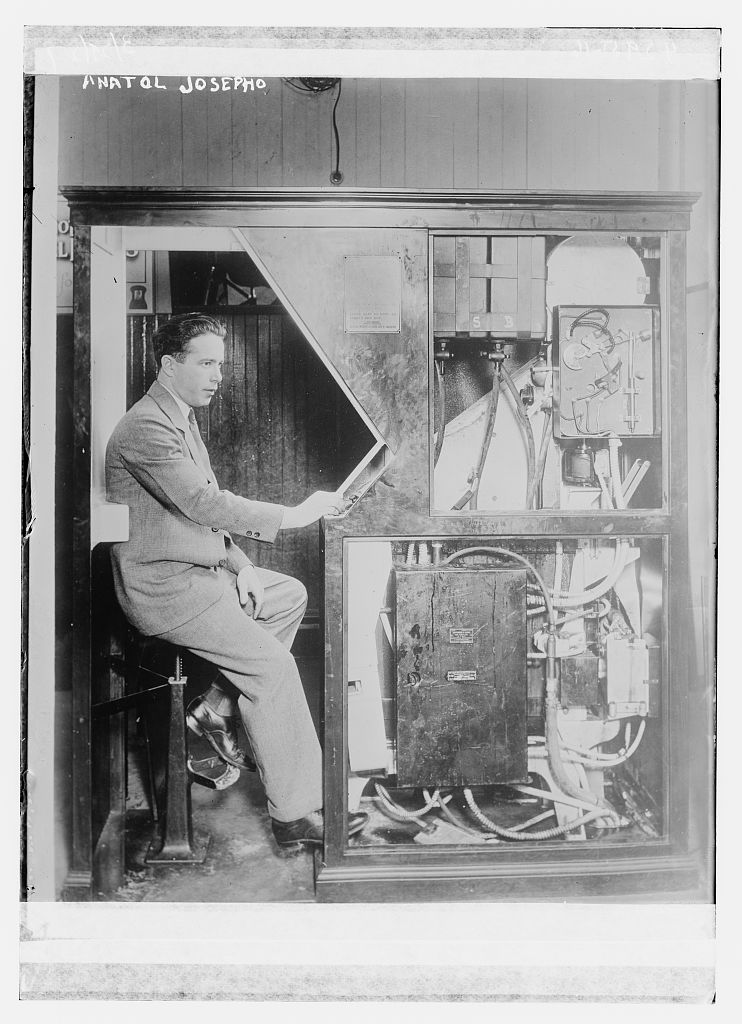
The Library of Congress holds a Bain News Service glass negative identified as Anatol Josepho, dated 29 March 1927. A collection record gives us a named person, a dated object and a traceable source. It does not turn every later caption or anecdote into contemporary evidence.
Evidence: Collection record
What a patent can tell us
A patent documents a design, not how every commercial machine operated. Read drawings together with filing and publication dates. The gaps between design, installation and commercial success are part of the story. Likewise, separate a contemporary newspaper’s report from a modern curator’s interpretation: each can be useful, but they answer different questions.
Evidence: Primary patent
Sources & further reading
Sources for the specific facts and product descriptions above. Our worked examples, interpretations and practical suggestions are original editorial guidance.
- National Archives of Hungary — Anatol Josepho and PhotomatonArchival research
- Library of Congress — Anatol Josepho, 29 March 1927Collection record
- Anatol M. Josepho — US patent 1,631,593Primary patent